
E-Bike Reviews
Heybike Ranger S Electric Bike: Specs, Features, and Fit

Introduction
Folding electric bikes usually ask riders to give something up. Compact folding usually means a smaller motor, a shorter range, or thinner tires that struggle once the pavement ends. The Heybike Ranger S gets searched so often because it seems to break that pattern, pairing a folding frame with a fat-tire build and motor options that go well beyond what most folding bikes offer. Readers usually want to know if that combination actually works, or if it’s just a longer spec sheet without the real-world performance to back it up.
This guide covers what the Ranger S actually includes, how its two motor versions differ, and where it fits best for real riders.
Direct Answer
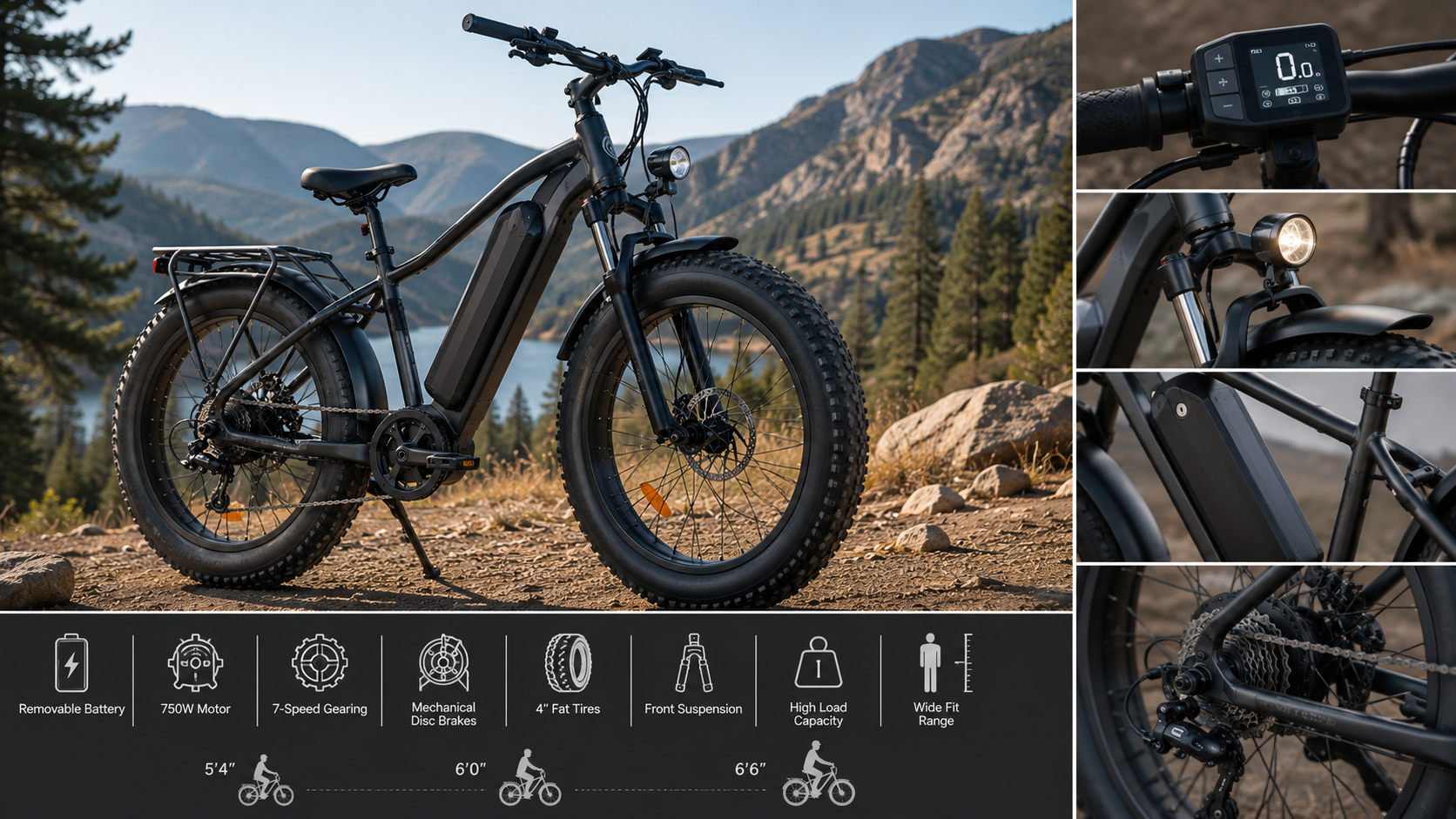
The Heybike Ranger S is a folding, fat-tire electric bike available with either a 750W or 1000W rear hub motor, paired with a 692Wh removable battery rated for up to 55 miles of range. It features a step-through aluminum frame, front hydraulic suspension, 20 x 4 inch tires, a Shimano 7-speed drivetrain, and a payload capacity of up to 400 pounds, making it suited for commuting, errands, and light off-road riding.
What Is the Heybike Ranger S?
The Ranger S sits in Heybike’s lineup as a folding e-bike built for riders who want more capability than a typical compact folder offers. Unlike many folding e-bikes designed mainly for short, flat commutes, the Ranger S uses fat tires and a stronger motor, positioning it as a bike that can handle gravel, light trails, or uneven pavement in addition to standard city riding.
It’s a follow-up to Heybike’s original Ranger model, with a redesigned frame that integrates the battery into the down tube for a cleaner look and reportedly sturdier folding mechanism. The step-through frame design keeps it accessible for a wide range of riders, while the folding hinge allows it to be compressed down to roughly 40 by 20 by 31 inches for storage or transport.
Key Specifications
Because the Ranger S is sold in two motor configurations, it’s important to know both sets of numbers before comparing prices or performance claims.
750W Motor Version
- Motor: 750W rear hub motor, peak output around 1200W, roughly 80Nm of torque
- Assist type: Cadence sensor pedal assist
- Top speed: Up to 28 mph on pedal assist (Class 3), with throttle-only speeds typically capped around 20 mph (Class 2)
1000W Motor Version
- Motor: 1000W rear hub motor, peak output around 1800W
- Assist type: Torque sensor pedal assist, which responds to how hard the rider pedals rather than just pedal rotation
- Top speed: Up to 32 mph on pedal assist
Shared Specifications
- Battery: 692Wh removable lithium-ion battery, UL 2849 safety certified
- Range: Up to 55 miles, depending on assist level, terrain, and rider weight
- Tires: 20 x 4 inch fat tires
- Brakes: Hydraulic disc brakes (standard on the 1000W version; some listings show mechanical disc brakes on earlier 750W units, so it’s worth confirming brake type on the specific listing before buying)
- Suspension: Front hydraulic suspension fork
- Drivetrain: Shimano 7-speed
- Frame: Step-through aluminum alloy, folding design
- Weight: Approximately 72 pounds
- Payload capacity: Up to 400 pounds combined rider and cargo weight
- Charger: Fast-charging 4-amp charger, with a full charge reported in roughly 3 to 4 hours
- Lighting: Front and rear LED lights with integrated turn signals
- Connectivity: Heybike smart app and LCD display
Specs can shift slightly between production batches, so checking the current listing before purchase is a reasonable habit for any e-bike, not just this one.
How the Ranger S’s Systems Work Together
Motor and Torque Delivery
Both motor versions are rear hub motors, meaning the motor is built into the rear wheel rather than at the crank. The torque figure, around 80Nm on the 750W version, measures rotational force and affects how quickly the bike accelerates from a stop or climbs a hill, independent of top speed. The 1000W version’s torque sensor is generally considered more responsive than a cadence sensor, since it adjusts assist based on how hard the rider is actually pushing the pedals rather than simply detecting that the pedals are turning.
Battery Capacity and Range
A 692Wh battery is on the larger side for a folding e-bike, which helps explain the bike’s 55-mile range ceiling despite its added weight and power. As with any e-bike, that top range figure reflects favorable conditions, low assist, flat terrain, and a lighter rider, so actual range for hillier routes or higher assist levels will run lower.
Suspension and Tires
The front hydraulic suspension fork combined with 4-inch-wide tires is what allows the Ranger S to handle gravel paths, sandy trails, or rough pavement more comfortably than a standard folding e-bike with narrow tires and no suspension. Wider tires lower ground pressure and improve traction on loose or uneven surfaces, at some cost to rolling efficiency on smooth pavement compared to narrower tires.
Folding Mechanism
The folding hinge is reinforced to support the added weight and power of the Ranger S compared to lighter folding e-bikes. This matters because a folding mechanism under strain from a heavier frame needs to hold up over repeated folding and unfolding without developing play or instability at the hinge.
Why This Combination of Features Matters
Most folding e-bikes are designed around portability first, which usually means a smaller motor, a narrower tire, and a lighter overall build. The Ranger S takes a different approach, prioritizing capability and range even though it adds weight and reduces how easily the bike can be carried. For a rider who wants one bike that can fold for storage in an apartment but also handle occasional gravel trails or steep neighborhood hills, this trade-off can make sense. For a rider who mainly needs a lightweight bike to carry onto a train or up a few flights of stairs daily, a lighter, less powerful folding bike may be a better fit.
Benefits of the Ranger S
Strong motor options for a folding e-bike, including a 1000W version with torque-sensing pedal assist for more natural power delivery.
Fat tires and front suspension that extend its usefulness beyond pavement, into gravel and light trail conditions.
Large payload capacity of up to 400 pounds, useful for larger riders or those planning to carry cargo.
Fast charging relative to many e-bikes in its category, cutting typical recharge time significantly.
Foldable design for storage in smaller homes or for transport in a vehicle trunk.
Limitations and Considerations
Heavier than most folding e-bikes. At around 72 pounds, the Ranger S is on the heavier end for a folding bike, which can make it harder to carry up stairs or lift into a vehicle regularly.
Motor performance can vary by unit and firmware. Independent testing has shown some gap between advertised peak wattage and observed real-world output on hill climbs, which is common across the e-bike industry but worth setting realistic expectations around.
Brake type may differ by version or batch. Since some listings describe mechanical disc brakes on certain configurations while others specify hydraulic, confirming the exact brake type on the specific unit being purchased avoids confusion later.
Higher top speeds require more rider awareness. A bike capable of 28 to 32 mph pedal assist speeds demands more attentive braking distance and traffic awareness than a standard Class 1 e-bike limited to 20 mph.
Classification affects where it can be ridden legally. Depending on configuration, the Ranger S may fall into Class 2 or Class 3 e-bike categories, which are subject to different rules on bike paths, trails, and roads depending on state or local law.
Step-by-Step: Setting Up the Ranger S
- Unbox and check included parts. Expect the frame, front wheel, pedals, handlebar stem, seat post, charger, and any included accessories like fenders.
- Unfold and lock the frame. Confirm the folding hinge locks securely before attaching remaining components.
- Attach the front wheel and handlebars. Follow manufacturer torque specifications where provided, since improperly tightened components are a common source of early issues.
- Install pedals correctly. Pedals thread in opposite directions on each side, so following the included instructions prevents cross-threading.
- Charge the battery fully before first use. This also confirms the charger and battery are functioning correctly out of the box.
- Check brakes and tire pressure. Given the higher top speed on this bike, confirming brake engagement before the first ride is especially important.
- Test the fold and unfold mechanism once more. Practicing this while stationary, before relying on it in public, helps build familiarity and confirms nothing was mis-assembled.
- Take a controlled first ride. A flat, open area allows a rider to get used to throttle response and pedal assist before heading into traffic or trail conditions.
Common Mistakes and Misconceptions
Assuming both motor versions perform identically. The 750W and 1000W versions differ not just in top speed, but in torque, assist type, and in some cases braking hardware, so comparing reviews without noting which version is being discussed can create confusion.
Treating peak wattage as sustained power. Peak output figures reflect short bursts, such as accelerating from a stop, not the motor’s continuous performance over a long climb.
Underestimating the bike’s weight when planning storage. At roughly 72 pounds, folding doesn’t necessarily mean easy to carry; riders in walk-up apartments should factor this in before assuming a folding bike solves a stair-carrying problem.
Ignoring speed classification when choosing where to ride. A Class 3-capable bike may not be allowed on certain bike paths or trails that restrict speed or motor class, regardless of how the rider intends to use it.
Assuming fat tires alone make a bike trail-ready. Fat tires help with traction and stability, but a bike’s suitability for genuine trail riding also depends on suspension travel, frame geometry, and braking power, not tire width alone.
Real-World Example
Picture a rider living in a small apartment who commutes three miles to work on paved roads but also wants to ride gravel paths on weekends. The Ranger S’s fold-down storage solves the apartment space problem, while its fat tires and front suspension make the weekend gravel rides comfortable, something a narrow-tire folding commuter bike wouldn’t handle as well.
Now picture a rider who primarily needs to carry a folding e-bike onto a bus or up several flights of stairs each day. For this rider, the Ranger S’s weight could become a daily inconvenience, even though its capability elsewhere is strong. In that case, a lighter folding e-bike built purely for portability might serve better, even with a smaller motor and shorter range.
Key Facts
- The Ranger S is a folding, fat-tire e-bike available in 750W and 1000W motor versions.
- Both versions share a 692Wh UL 2849-certified battery rated for up to 55 miles of range.
- Top pedal-assist speed reaches up to 28 mph on the 750W version and up to 32 mph on the 1000W version.
- It uses 20 x 4 inch tires, a front hydraulic suspension fork, and a Shimano 7-speed drivetrain.
- Payload capacity is rated up to 400 pounds combined rider and cargo weight.
- The bike weighs approximately 72 pounds and folds down to roughly 40 x 20 x 31 inches.
- A 4-amp fast charger can refill the battery in about 3 to 4 hours.
FAQ
What is the Heybike Ranger S?
It’s a folding, fat-tire electric bike available in 750W and 1000W motor versions, built for commuting, errands, and light off-road riding, with a 692Wh battery rated for up to 55 miles of range.
How does the Ranger S differ between motor versions?
The 750W version uses a cadence sensor and reaches up to 28 mph on pedal assist, while the 1000W version uses a more responsive torque sensor and reaches up to 32 mph.
Why choose a folding e-bike with fat tires instead of a standard folder?
Fat tires and front suspension let the Ranger S handle gravel, sand, or rough pavement better than most folding e-bikes, which are typically built for smooth, flat commuting only.
Is the Ranger S safe to ride at higher speeds?
Its hydraulic suspension and disc brakes (on most configurations) support stable handling at higher speeds, but riders should factor in longer stopping distances and greater traffic awareness compared to lower-speed e-bikes.
Is it legal to ride on all bike paths?
That depends on local e-bike classification laws. Because the Ranger S can reach Class 2 or Class 3 speeds depending on configuration, some bike paths or trails may restrict its use.
What are the alternatives to the Ranger S?
Alternatives include lighter folding e-bikes built purely for portability, other Heybike models with different frame styles, and folding e-bikes from competing direct-to-consumer brands with similar fat-tire designs.
What should buyers know before purchasing?
Buyers should confirm which motor version and brake type they’re purchasing, understand that the bike’s roughly 72-pound weight limits easy carrying, and check local e-bike classification rules for their intended riding routes.
Key Takeaways
- The Heybike Ranger S is a folding, fat-tire e-bike offered in 750W and 1000W motor versions.
- Both versions share a 692Wh battery rated for up to 55 miles of range, though real-world results vary with terrain and assist level.
- Front hydraulic suspension and 4-inch tires extend its capability beyond pavement into gravel and light trail use.
- At around 72 pounds, it’s heavier than most folding e-bikes, which matters for daily carrying.
- Higher top speeds on this bike require more attentive braking and awareness of local e-bike classification rules.
- Confirming the exact motor version and brake type on a specific listing avoids confusion when comparing reviews or prices.
Conclusion
The Heybike Ranger S stands out among folding e-bikes by prioritizing power, range, and off-pavement capability over minimal weight, giving riders a bike that can fold for storage while still handling gravel paths and steeper climbs. Choosing between its two motor versions, and understanding the trade-offs around weight and local speed classifications, will help riders decide whether it fits their specific commuting and recreational needs.
Introduction
Most e-bikes are built for pavement. Fewer are built to handle sand, mud, and steep dirt trails without feeling out of place doing it. That’s the gap the Heybike Brawn tries to fill: an electric bike styled after a motorcycle, with the tires and suspension to back up its off-road claims.
People searching for the Heybike Brawn usually want to know a few specific things. How much power does it actually have? How far can it go before the battery runs out? Is it really capable off-road, or is the styling just for looks? This guide walks through the bike’s design, performance, and trade-offs so you can judge whether it matches how you’d actually ride it.
Direct Answer: What Is the Heybike Brawn?
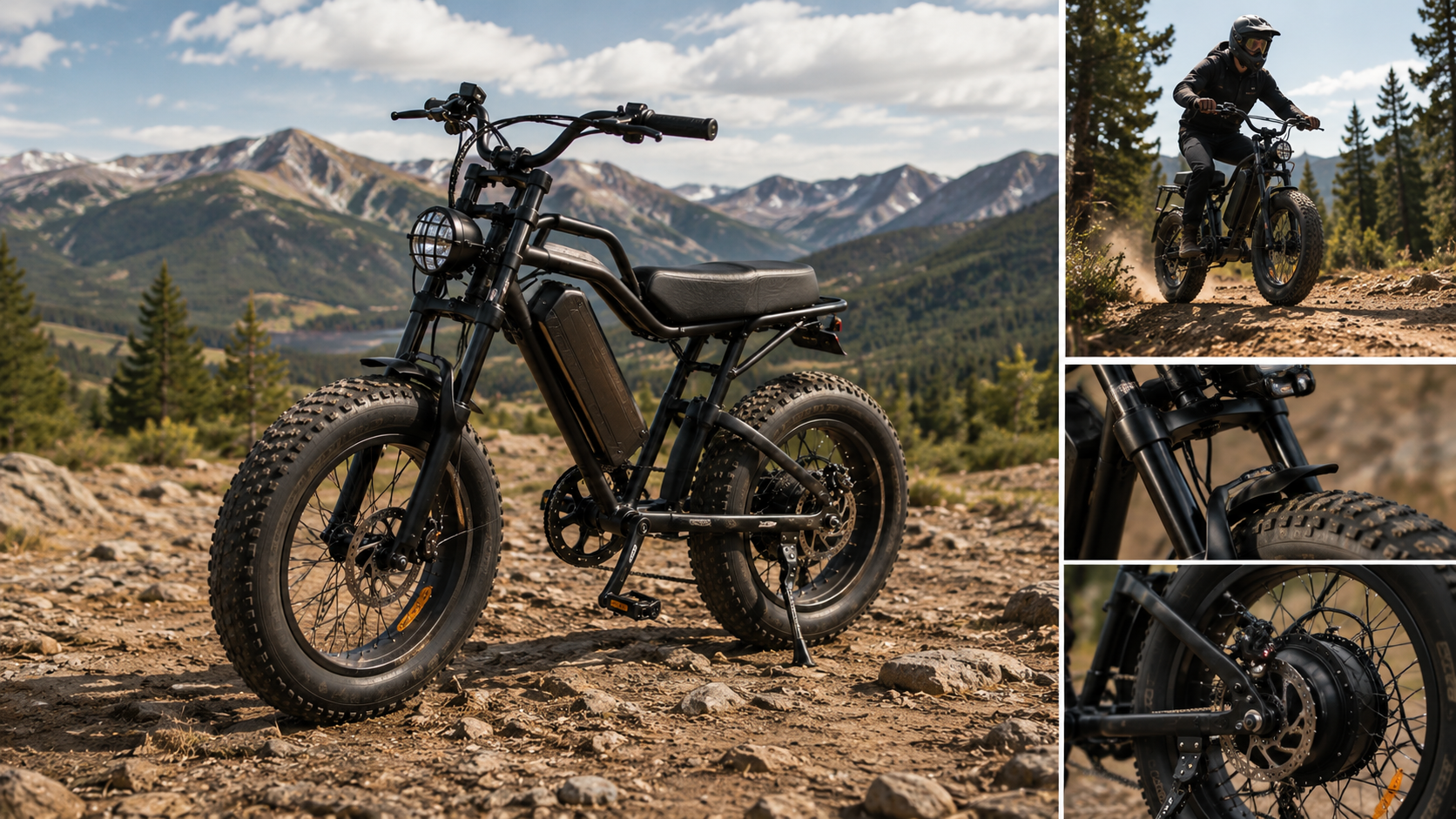
The Heybike Brawn is a Class 3 electric bike with a 750W rear-hub motor, a peak output near 1200 to 1400W, and roughly 80Nm of torque. It uses a large battery, typically between 840Wh and 864Wh, offering a manufacturer-estimated range of up to 65 miles under pedal assist. Built with 26 x 4 inch fat tires, a dual-crown suspension fork, and a hydraulic seat post, it’s designed for both commuting and off-road riding, reaching speeds up to 28 mph.
What Makes the Brawn Different From a Typical Fat Tire E-Bike
Fat tire e-bikes are common, but most stick to a fairly standard look: a single suspension fork, a step-through or step-over frame, and styling closer to a traditional bicycle. The Heybike Brawn takes a different visual approach, borrowing design cues directly from motorcycles, including a dual-crown front fork and a large integrated headlight.
That styling isn’t purely cosmetic. A dual-crown fork, where the fork legs are clamped above and below the head tube rather than just below it, generally offers more rigidity and better handling under stress, a feature more common on downhill mountain bikes and motorcycles than standard e-bikes. Combined with wide 26 x 4 inch tires, this gives the Heybike Brawn a stronger foundation for uneven, unpredictable terrain than many fat tire e-bikes in its price range.
Key Specifications
- Motor: 750W rear-hub motor, peak output between roughly 1200W and 1400W depending on configuration
- Torque: Approximately 80Nm
- Top speed: Up to 28 mph (Class 3)
- Battery: 48V, roughly 840Wh to 864Wh, depending on model year
- Range: Up to 65 miles under pedal assist; shorter under throttle-only use
- Tires: 26 x 4 inch fat tires
- Suspension: Dual-crown front fork, hydraulic seat post
- Brakes: Hydraulic disc brakes
- Gearing: Shimano 7-speed drivetrain
- Display: Backlit LCD with Bluetooth app connectivity
- Payload capacity: Up to 400 pounds
- Charge time: Roughly 4 to 5 hours from empty
How the Motor and Battery Work Together
Numbers on a spec sheet only explain part of how a bike performs, so it helps to look at how the motor and battery interact during actual riding.
The Heybike Brawn’s 750W hub motor is rated to reach peak output figures reported between 1200W and 1400W across different model years and retailer listings. That peak number represents a short burst of extra power, typically used when accelerating from a stop or climbing a steep section, while 750W represents the motor’s sustained output during normal riding. The bike’s roughly 80Nm of torque is what gives it strong low-end acceleration, a trait reviewers have consistently pointed to when describing how quickly the Brawn reaches its 28 mph top speed compared to lower-torque e-bikes.
Battery capacity plays an equally large role. At roughly 840 to 864 watt-hours, the Brawn’s battery is larger than what’s typically found on standard commuter e-bikes, which often sit closer to 500 to 700Wh. This larger capacity is a major reason the bike can support a manufacturer-estimated range of up to 65 miles. That figure applies specifically to pedal-assist riding under favorable conditions. Riders using throttle-only mode, a common testing method used by reviewers, have reported ranges closer to 45 miles, and real-world range in hilly or off-road terrain will typically fall somewhere below both figures depending on rider weight and terrain.
Why Off-Road Capability Depends on More Than the Motor
A powerful motor helps, but off-road performance depends just as much on suspension, tire width, and braking control. The Heybike Brawn combines several of these elements in a way that’s less common among off-road-styled e-bikes at this price point.
The dual-crown front fork absorbs impact from rocks, roots, and uneven trail surfaces, reducing the shock that would otherwise transfer directly to the rider’s arms and shoulders. The hydraulic seat post adds a second layer of comfort, allowing riders to adjust saddle height on the fly, a feature usually reserved for higher-end mountain bikes. Wide 26 x 4 inch tires lower ground pressure, which is part of why testers have reported the Brawn handling soft sand without getting bogged down, a common failure point for narrower tires.
Braking matters just as much on unpredictable terrain. The Brawn uses hydraulic disc brakes, which provide more consistent stopping power than mechanical disc brakes, particularly in wet or muddy conditions where braking force needs to be applied gradually and predictably.
Step-by-Step: What to Check Before Your First Ride
Whether the Heybike Brawn is brand new or has been sitting unused for a while, a quick pre-ride check helps avoid problems on the trail.
- Check tire pressure. Fat tires perform differently depending on pressure. Lower pressure improves traction on sand or loose dirt, while higher pressure suits paved commuting.
- Test the hydraulic seat adjustment. Confirm the seat post moves smoothly and locks securely at the desired height before riding.
- Inspect the brakes. Squeeze both brake levers to confirm even, quiet engagement. Some early units have reported brake noise, which is worth addressing before heading out.
- Confirm the battery charge level. Since the Brawn is often used for longer off-road rides, checking charge status ahead of time avoids getting stranded farther from home.
- Review the gear range on the display. The Shimano 7-speed drivetrain has a narrower gear range than dedicated mountain bikes, which matters most on steep climbs.
- Pair the Heybike app, if desired. The app allows riders to adjust pedal assist settings and track ride data, though it isn’t required for basic operation.
Common Mistakes and Misconceptions
Assuming peak wattage reflects everyday power. The 1200W to 1400W peak figures represent short bursts under load. The motor’s continuous rated output is 750W, which is what it sustains during normal riding.
Expecting the full 65-mile range on every ride. That number reflects pedal-assist riding under ideal conditions. Throttle-only use, hilly terrain, or heavier riders will reduce range, sometimes by close to half.
Assuming the bike comes with fenders. Some model years of the Heybike Brawn ship without fenders by default, a deliberate design choice intended to prevent mud buildup during off-road riding, which can otherwise clog narrow-clearance fenders and stop the bike.
Overlooking Class 3 speed regulations. With a 28 mph top speed, the Brawn falls into the Class 3 e-bike category in regions that use this classification system, which can restrict where it’s legally allowed to ride, including certain bike paths and trails.
Assuming all model years have identical specs. Battery capacity and peak motor output have varied slightly across different production years and retailer listings, so it’s worth confirming current specifications directly before comparing older reviews to a current purchase.
Real-World Riding Scenarios
A rider tackling mixed terrain on weekends. Someone splitting time between paved roads during the week and dirt trails or beach rides on weekends benefits from the Brawn’s wide tires and dual-crown suspension, which perform well across both surface types.
A commuter who wants extra range margin. A rider commuting a moderate distance daily may appreciate the larger battery capacity, since it provides a bigger buffer against range loss from cold weather, hills, or higher assist levels.
An off-road enthusiast testing soft terrain. Reviewers have specifically noted the Brawn’s ability to handle soft sand without sinking, making it a reasonable option for beach or dune-adjacent riding where narrower-tired e-bikes typically struggle.
Benefits and Limitations
Benefits
- Strong torque and peak power output for quick acceleration and hill climbing
- Larger-than-average battery capacity supports longer rides
- Dual-crown fork and hydraulic seat post improve comfort on rough terrain
- Wide fat tires handle sand, mud, and loose dirt effectively
- High payload capacity supports heavier riders or light cargo
Limitations
- Some model years ship without fenders, which affects paved commuting in wet weather
- Real-world range varies significantly based on riding style and terrain
- Shimano 7-speed drivetrain has a narrower gear range than dedicated mountain bikes
- Some early units have reported brake noise or drivetrain adjustment issues
- 28 mph top speed may place it under stricter regional e-bike regulations
Key Facts
- The Heybike Brawn uses a 750W rear-hub motor with a peak output reported between 1200W and 1400W, along with roughly 80Nm of torque.
- Battery capacity is typically 840Wh to 864Wh, supporting an estimated range of up to 65 miles under pedal assist.
- Top speed is up to 28 mph, placing it in the Class 3 e-bike category in regions that use this system.
- It uses 26 x 4 inch fat tires, a dual-crown suspension fork, and hydraulic disc brakes.
- Payload capacity is rated up to 400 pounds.
- Charging from empty typically takes 4 to 5 hours.
Frequently Asked Questions
What is the Heybike Brawn?
The Heybike Brawn is a motorcycle-styled electric bike built for both commuting and off-road riding, featuring a 750W motor, a large battery, fat tires, and dual suspension components.
How fast does the Heybike Brawn go?
It reaches speeds up to 28 mph, which classifies it as a Class 3 e-bike in regions using that classification system.
How far can the Heybike Brawn travel on one charge?
Heybike estimates up to 65 miles under pedal-assist riding. Throttle-only use typically reduces that to around 45 miles, and hilly or off-road terrain will reduce it further.
Is the Heybike Brawn good off-road?
Its wide 26 x 4 inch tires, dual-crown suspension fork, and hydraulic seat post are specifically suited to uneven terrain, and testers have reported it performing well on sand, dirt, and rocky trails.
Is the Heybike Brawn legal to ride on bike paths?
This depends on local e-bike regulations. Its 28 mph top speed places it in the Class 3 category in many regions, which can affect where it’s legally allowed to ride, so checking local rules is important before assuming unrestricted access.
What are the alternatives to the Heybike Brawn?
Alternatives include other Class 3 fat tire e-bikes with single suspension forks and smaller batteries, as well as dedicated electric mountain bikes for riders focused primarily on technical trail riding rather than mixed commuting and off-road use.
What should someone know before buying a Heybike Brawn?
Buyers should understand that peak power figures don’t reflect sustained output, that real-world range depends heavily on riding style, and that some model years ship without fenders, which matters for anyone planning to commute in wet conditions.
Key Takeaways
- The Heybike Brawn combines a 750W motor, roughly 80Nm of torque, and a large battery built for both power and range.
- Its dual-crown fork, hydraulic seat post, and wide fat tires are specifically suited to off-road and mixed-terrain riding.
- Real-world range and hill performance vary based on riding style, terrain, and rider weight.
- A 28 mph top speed may place the Brawn under stricter e-bike regulations in some regions.
- Some model years ship without fenders, a trade-off aimed at improving off-road performance.
Conclusion
The Heybike Brawn is built around a specific idea: an e-bike that looks and performs like it belongs off pavement, without giving up the power needed for daily commuting. Its motor, suspension, and tire setup reflect that focus, and the trade-offs, like the lack of fenders on some model years and a narrower gear range, are worth understanding rather than treating as flaws. Looking at how the motor, battery, and suspension work together gives a clearer sense of whether the Heybike Brawn fits the kind of riding someone actually plans to do.
-
 E-Bike News4 weeks ago
What Is a Bike Stand? A Complete Guide to Types, Uses, and How to Choose One
-
 E-Bike News4 weeks ago
What Is an Elliptical Bike? A Complete Guide to How It Works, Benefits, and What to Know Before You Try One
-

 E-Bike News3 weeks ago
What Is a Beach Cruiser? A Complete Guide to Comfort Bikes for Easy Riding
-
 E-Bike Technology3 weeks ago
Pocket Rocket Folding Road Bikes: What They Are and How They Work
-
 E-Bike News4 weeks ago
Electric Commuter Bike: What It Is and How to Choose the Right One
-

 E-Bike News2 weeks ago
Sleeping on a Bike: Why It Happens and How to Stay Safe While Riding
-
 E-Bike News3 weeks ago
Types of Bikes: A Complete Guide to Choosing the Right One
-
 E-Bike Technology4 weeks ago
What Is a Sirrus Bike? A Complete Guide to the Specialized Sirrus Line